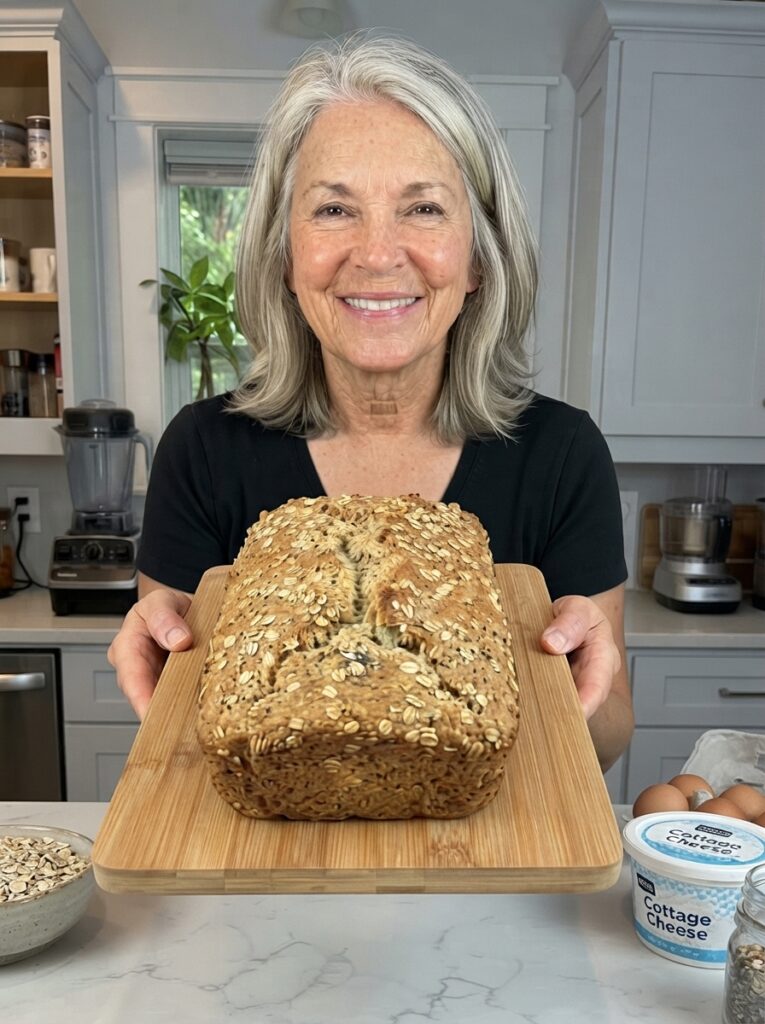
Cottage Cheese Oatmeal Bread is a savory-leaning quick loaf with a moist crumb and a gentle oat flavor. Blended cottage cheese and eggs form the creamy base, while rolled oats and a little wheat flour give the bread structure. Baking powder supplies the lift, so there is no yeast or dough proofing.
Serve a lightly toasted slice with butter, eggs, or avocado, or put it alongside soup. A short oat-soaking rest softens the flakes, and cooling after baking helps the loaf become easier to cut.
This version uses both oats and all-purpose flour. It is a tender, relatively close-textured quick bread rather than a fluffy yeast sandwich loaf. The ingredients and method below are a proposed formula developed from the recipe title; a test bake is needed to confirm the final timing and texture before publication as a tested recipe.
Recipe at a glance: One 8½-by-4½-inch loaf · about 10 slices · 15 minutes active prep · 15 minutes oat hydration · approximately 45–55 minutes baking · 10 minutes pan rest, plus full cooling.
Why You’ll Love This Bread
- No yeast or kneading: Mix a thick batter and bake.
- Oat texture: Rolled oats add a pleasant chew without requiring homemade oat flour.
- A creamy base: Cottage cheese contributes moisture and dairy protein.
- Modest sweetness: A little optional honey suits breakfast without making a dessert loaf.
- Convenient slices: Toast or freeze individual portions.
What Is Cottage Cheese Oatmeal Bread?
This is a chemically leavened loaf with rolled oats, wheat flour, cottage cheese, and eggs. The flour supports slicing, while the oats absorb moisture and remain slightly textured.
The word oatmeal refers to the oats in the loaf; the recipe does not use a bowl of already cooked oatmeal. Cooked oatmeal has a different moisture balance and is not a direct substitute.
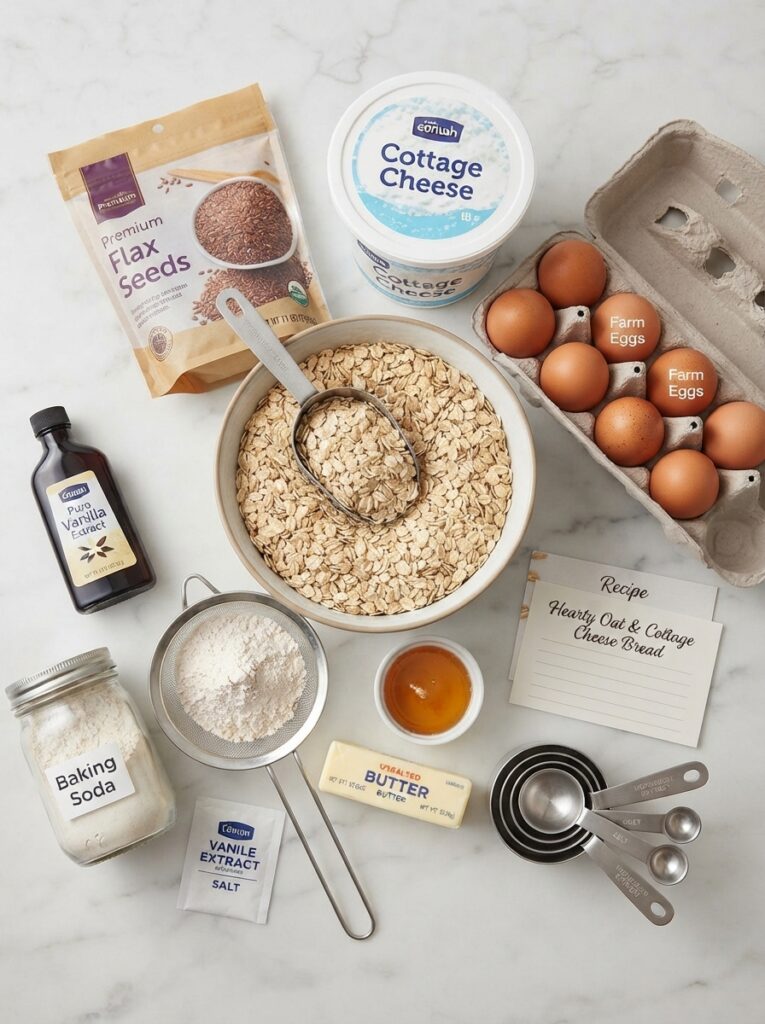
Ingredients
- 1 cup plain cottage cheese
- 2 large eggs
- ½ cup milk
- 2 tablespoons olive oil or melted, cooled butter
- 1 tablespoon honey, optional
- 1½ cups old-fashioned rolled oats
- 1 cup all-purpose flour, spooned and leveled
- 2 teaspoons baking powder
- ½ teaspoon fine salt
- 1 tablespoon rolled oats for the top, optional
Ingredient Notes
Cottage cheese: Use plain cottage cheese. Full-fat and reduced-fat varieties differ in richness and moisture. Drain excessive loose liquid before measuring, without pressing the curds completely dry.
Eggs: Two large eggs help the batter set. Omitting eggs or replacing them with another binder requires a separately adjusted formula.
Milk: Provides liquid for oat hydration. Dairy milk is a straightforward choice; an unsweetened plant-based milk changes flavor and nutrition but can be tried as a variation.
Oil or butter: Adds tenderness. Cool melted butter before combining it with eggs. Choose one rather than adding both.
Honey: Optional for a hint of sweetness. The loaf is not intended as a sweet cake.
Rolled oats: Use old-fashioned rolled oats, not steel-cut oats. Steel-cut oats require different hydration and cooking. Quick oats absorb differently and produce a finer texture, so old-fashioned oats are recommended for the proposed formula.
Flour: All-purpose wheat flour gives structure. The loaf is not flour-free or gluten-free. Do not substitute oat flour for the entire wheat quantity without adjusting the formula.
Baking powder: Use fresh baking powder, not baking soda. No yeast rising period is needed.
Equipment
Use an 8½-by-4½-inch metal loaf pan, blender or food processor, two bowls, a spatula, and a wire rack. Line the pan with parchment or grease it thoroughly with a small additional amount of oil or butter.
A larger pan produces a shallower loaf. A smaller, deeper pan may need substantially longer to bake the center. Pan size matters for a moist quick bread.
How to Make It
1. Prepare the oven and pan
Preheat to 350°F. Prepare the pan and set an oven rack near the middle.
2. Blend the wet ingredients
Blend cottage cheese, eggs, milk, oil or cooled butter, and optional honey until mostly smooth. Transfer to a bowl.
Blending before adding flour smooths the curds without overworking the final batter.
3. Hydrate the oats
Stir the rolled oats into the wet base and rest for 15 minutes. This gives them time to soften and absorb some liquid.
The mixture will thicken. This is an oat-hydration rest, not yeast proofing; it should not double in volume.
4. Add the dry ingredients
Whisk flour, baking powder, and salt separately. Fold into the oat mixture until no dry flour remains.
Expect a thick, spoonable batter. Avoid prolonged stirring. If it is unusually dry or runny, recheck quantities rather than making large unmeasured additions; cottage cheese moisture and oat absorption affect the proposed formula.
5. Fill and bake
Spoon into the pan and smooth the surface. Add the optional tablespoon of oats, pressing lightly so they adhere.
Bake for approximately 45–55 minutes, beginning to check around 45 minutes. The center should be set, and a skewer should come out without wet batter. Continue in 5-minute increments if necessary, tenting loosely with foil if the top darkens early.
Because this formula has not been test-baked, the stated range is provisional. Do not remove a wet-centered loaf simply to match the timer.
6. Cool before slicing
Rest in the pan for 10 minutes, then transfer to a rack. Allow full cooling before cutting into approximately ten slices. Warm oat-rich quick bread can appear sticky or compress when sliced.
Keep cooling and packing within the 2-hour window before refrigeration. Do not leave the moist egg-and-dairy loaf on the counter overnight.
Tips for Better Texture
Hydrate the oats first. Dry flakes added at the last moment can absorb liquid unevenly.
Measure flour lightly. Packing cups increases the chance of a heavy loaf.
Mix briefly after flour. Stir to combine, not to develop a kneaded dough.
Check the center. A brown surface can hide wet batter.
Cool fully for slices. The crumb needs time to set after baking.
Toast if desired. Toasting gives moist slices a firmer surface for toppings.
Troubleshooting
| Problem | What to check |
|---|---|
| Center is wet | Continue baking, protecting the top with foil. Verify pan size and quantities. |
| Slices are gummy while warm | Allow complete cooling; also distinguish a soft hot crumb from uncooked batter. |
| Loaf is dense | Some density is expected. Check baking powder freshness, flour measurement, and mixing. |
| Oats feel firm | Use rolled oats and complete the hydration rest; steel-cut oats are not suitable here. |
| Top burns early | Tent loosely and check the oven temperature. |
| Loaf crumbles | Cool before slicing and verify eggs and flour were measured as written. |
Optional Variations
Savory herb: Omit honey and add ½ teaspoon dried Italian seasoning.
Cheddar accent: Fold in a modest ¼ cup shredded cheddar, recognizing that it changes fat and salt content.
Seeded top: Replace some topping oats with a small amount of sesame or sunflower seeds.
Breakfast flavor: Add a little cinnamon if you prefer a gently sweet version with the optional honey.
These variations also require testing for final texture. Large wet additions, gluten-free flour substitutions, and egg replacements change the structure substantially.
Serving Suggestions
Toast and serve with butter, cream cheese, avocado, or cooked eggs. For lunch, use moderately thick cooled slices with turkey or cheese, keeping wet fillings modest.
A slice alongside tomato soup or vegetable soup is another simple option. This is not automatically a low-carb loaf: oats and wheat flour both contribute carbohydrates.
Storage and Reheating
Refrigerate within 2 hours of baking, or within 1 hour above 90°F. Store covered at 40°F or below and use within 3–4 days. Allow initial steam to escape before packing tightly, without leaving it out for hours.
Freeze cooled slices with parchment between them for up to 2 months for best quality. Use a freezer-safe container or bag.
Thaw in the refrigerator or toast manageable slices from frozen, checking that the centers warm. A toaster oven offers control for thick, moist slices. Microwave briefly if you prefer a softer texture.
Nutrition Notes
Cottage cheese and eggs contribute protein, but this title alone does not justify a specific protein or calorie claim. Calculate using actual ingredient labels, optional additions, and ten equal slices if tracking nutrition.
The base contains wheat, milk, and eggs. Certified gluten-free oats alone do not make a loaf containing wheat flour gluten-free.
Frequently Asked Questions
Can I use cooked oatmeal?
No direct substitution is recommended. It contains a different amount of water and changes the batter.
Can I use steel-cut oats?
Not with this method. Their texture and hydration requirements differ from rolled oats.
Is there yeast?
No. Baking powder gives lift during baking, and the oat rest is only for hydration.
Can I use self-rising flour?
Not with the full added baking powder and salt. All-purpose flour is specified for this formula.
Can I make it gluten-free?
That requires a separately adjusted and tested formula, with suitable flour and oats. A direct swap is not established here.
Can I double it?
Bake in two similar pans rather than one much deeper loaf and check both independently.
Recipe Card
Cottage Cheese Oatmeal Bread
A proposed yeast-free loaf with rolled oats, wheat flour, cottage cheese, and eggs.
Active prep: 15 minutes
Oat hydration: 15 minutes
Bake: Approximately 45–55 minutes
Pan rest: 10 minutes
Total before full cooling: Approximately 1 hour 25 minutes–1 hour 35 minutes
Yield: One loaf, about 10 slices
Ingredients
- 1 cup plain cottage cheese
- 2 large eggs
- ½ cup milk
- 2 tablespoons olive oil or melted, cooled butter
- 1 tablespoon honey, optional
- 1½ cups old-fashioned rolled oats
- 1 cup all-purpose flour, spooned and leveled
- 2 teaspoons baking powder
- ½ teaspoon fine salt
- 1 tablespoon oats for topping, optional
Instructions
- Heat oven to 350°F and grease or line an 8½-by-4½-inch metal loaf pan.
- Blend cottage cheese, eggs, milk, oil or butter, and optional honey until mostly smooth.
- Stir in rolled oats and rest 15 minutes.
- Whisk flour, baking powder, and salt separately, then fold into the wet mixture just until combined.
- Spoon into the pan, smooth, and add optional topping oats.
- Bake approximately 45–55 minutes, or longer until the center is set and no wet batter remains on a skewer. Tent a dark top with foil.
- Rest 10 minutes in the pan, transfer to a rack, and cool before slicing. Refrigerate within 2 hours of baking.
Notes
- Formula and timing are proposed and require a test bake before publication as tested.
- Use rolled oats, not cooked oatmeal or steel-cut oats.
- Cooling time is additional to the listed total.
- Exact nutrition has not been calculated.
Final Thoughts
Give the oats their short hydration rest, mix gently after adding flour, and check the baked center carefully. Once cooled, the loaf offers a moist, savory-leaning slice for toast, breakfast, or soup.
Print
COTTAGE CHEESE OATMEAL BREAD
Ingredients
- 1 cup plain cottage cheese
- 2 large eggs
- ½ cup milk
- 2 tablespoons olive oil or melted, cooled butter
- 1 tablespoon honey, optional
- 1½ cups old-fashioned rolled oats
- 1 cup all-purpose flour, spooned and leveled
- 2 teaspoons baking powder
- ½ teaspoon fine salt
- 1 tablespoon oats for topping, optional
Instructions
- Heat oven to 350°F and grease or line an 8½-by-4½-inch metal loaf pan.
- Blend cottage cheese, eggs, milk, oil or butter, and optional honey until mostly smooth.
- Stir in rolled oats and rest 15 minutes.
- Whisk flour, baking powder, and salt separately, then fold into the wet mixture just until combined.
- Spoon into the pan, smooth, and add optional topping oats.
- Bake approximately 45–55 minutes, or longer until the center is set and no wet batter remains on a skewer. Tent a dark top with foil.
- Rest 10 minutes in the pan, transfer to a rack, and cool before slicing. Refrigerate within 2 hours of baking.